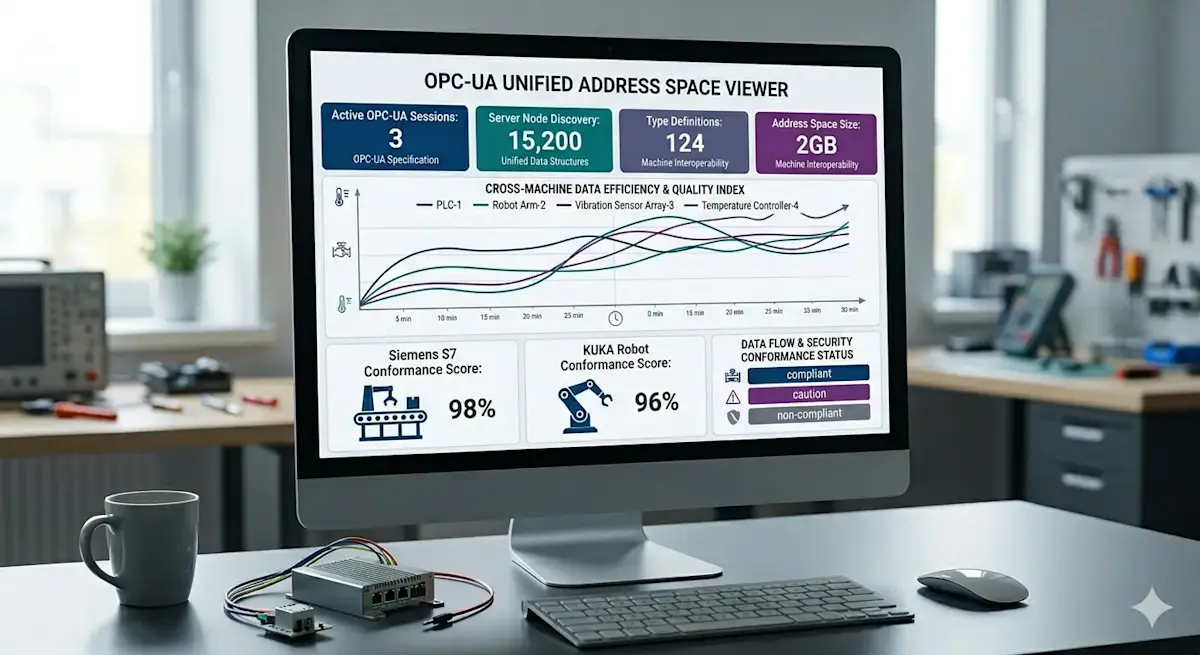
What is OPC-UA and Why Every SCADA Developer Should Know It
OPC-UA is the protocol that finally gave industrial machines a common language. If you work with SCADA or IIoT, this is the spec worth understanding.
For decades, industrial automation relied on a patchwork of proprietary protocols and vendor-specific drivers. A SCADA system communicating with a Siemens PLC required one driver. Connecting to a Rockwell controller required another. Integrating a third-party sensor often meant writing custom serial code. This fragmentation increased engineering costs, slowed project timelines, and created brittle systems that resisted change.
OPC Unified Architecture (OPC-UA) was designed to end that fragmentation. It is not merely another protocol in the crowded industrial landscape. It is a comprehensive framework for data exchange that addresses security, data modeling, and platform independence in ways that earlier standards never attempted.
The Evolution from OPC Classic
To understand OPC-UA, it is useful to understand what it replaced. The original OPC (OLE for Process Control) specification emerged in the mid-1990s. It provided a standardized way for Windows applications to communicate with PLCs and other industrial devices. The standard relied heavily on Microsoft COM and DCOM technologies, which effectively chained it to the Windows operating system.
This dependency created several practical problems. Configuring DCOM security across network boundaries was notoriously difficult and error-prone. The reliance on Windows prevented OPC servers from running on Linux-based edge devices or embedded controllers. As industrial networks became more connected to enterprise systems and the internet, the security limitations of DCOM became increasingly untenable.
OPC-UA, first released in 2008, eliminated these constraints. The architecture was redesigned from the ground up to be platform-agnostic, secure by design, and capable of modeling complex data relationships beyond simple point values.
What Makes OPC-UA Different
OPC-UA operates on a service-oriented architecture. A client sends a request to a server, and the server responds. The communication can occur over TCP with a binary protocol optimized for high throughput, or over HTTPS with XML or JSON encoding for firewall-friendly web integration. This dual transport capability allows the same protocol to function effectively on the factory floor and in the cloud.
Platform Independence
The specification defines the wire protocol and the information model without referencing any particular operating system or programming language. OPC-UA servers and clients exist for Windows, Linux, macOS, Android, iOS, and embedded real-time operating systems. A sensor running an OPC-UA server on a lightweight ARM processor can expose its data to a SCADA system running on Windows Server, a historian running on Linux, and a mobile maintenance application running on an iPad. The protocol is the common denominator.
Security as a First-Class Feature
Security in OPC-UA is not an optional add-on or a configuration burden left to the system integrator. The specification mandates support for authentication, authorization, encryption, and data integrity. Clients and servers exchange X.509 certificates to establish trust. Communication sessions are encrypted using industry-standard algorithms. Users can be authenticated against the server's internal user database or against external directory services.
This built-in security model contrasts sharply with Modbus TCP, which transmits data in plaintext and provides no native authentication. It also improves upon the DCOM security model of OPC Classic, which was complex to configure and often bypassed entirely in favor of expedience. With OPC-UA, secure communication is the default, not an afterthought.
The Address Space and Information Modeling
This is where OPC-UA transcends the capabilities of simple register-based protocols. In Modbus, a temperature value is just a number stored at address 40001. The client must know, out of band, that this number represents degrees Celsius, that it is scaled by a factor of ten, and that an engineering unit of "°C" applies.
OPC-UA servers expose an address space that contains not just the current value, but also metadata describing the value. A temperature node includes properties for the engineering unit, the valid operating range, the timestamp of the last update, and the quality of the data. This self-describing nature allows client applications to discover the meaning of data without consulting external documentation.
The information model extends beyond simple variables. OPC-UA defines standard object types for common industrial entities: motors, valves, tanks, controllers. A server can expose a motor object that contains variables for speed and current, methods for starting and stopping, and events that fire when a fault occurs. Clients can browse this structured information, understanding the relationships between components without prior programming.
Events and Alarms
Polling a value to detect a change is inefficient. OPC-UA includes a robust eventing subsystem that allows servers to push notifications to clients when specific conditions occur. Alarms can be acknowledged, shelved, and tracked with full audit trails. The server maintains the state of each alarm, ensuring that multiple clients see a consistent view of the plant condition.
The Role of OPC-UA in SCADA and IIoT
For SCADA developers, OPC-UA offers a unified interface to the plant floor. A single OPC-UA client can communicate with PLCs, HMIs, historians, and edge gateways from different vendors without custom drivers. The security model satisfies the requirements of modern industrial cybersecurity standards, including IEC 62443.
For IIoT applications, OPC-UA provides a standardized path to the cloud. Major cloud platforms, including AWS IoT SiteWise and Microsoft Azure IoT Operations, offer native OPC-UA ingestion. An edge gateway can aggregate data from multiple OPC-UA servers and forward it to cloud services using MQTT or direct OPC-UA over HTTPS. The data retains its semantic context throughout the journey.
Practical Considerations
Adopting OPC-UA requires a shift in thinking. The protocol is more complex than Modbus, and the information model requires upfront design to be fully effective. However, the benefits compound over the lifecycle of a system. A well-modeled OPC-UA server makes future integrations easier and reduces the tribal knowledge required to maintain the system.
Many modern PLCs now include embedded OPC-UA servers. Even for legacy equipment without native support, gateway devices can translate Modbus, EtherNet/IP, or Profinet to OPC-UA, providing a bridge to modern infrastructure.
OPC-UA is not a replacement for real-time fieldbuses like EtherCAT or Profinet IRT. Those protocols handle deterministic motion control at microsecond speeds. OPC-UA operates one level higher, at the supervisory and enterprise integration layers. The two classes of protocol coexist because they serve different purposes.
For any SCADA developer or IIoT architect, understanding OPC-UA is no longer optional. It is the common language that finally allows industrial machines to speak to each other and to the broader enterprise in a secure, discoverable, and semantically rich way.
Discussion
Sign in to join the discussion.
Sign in →No comments yet. Be the first.